School Wide Positive Behaviour Support (SWPBS)
Our Commitment
Thomastown Meadows Primary School is committed to implementing School Wide Positive Behaviour Support (SWPBS) to promote a positive, safe and inclusive learning environment for all students.
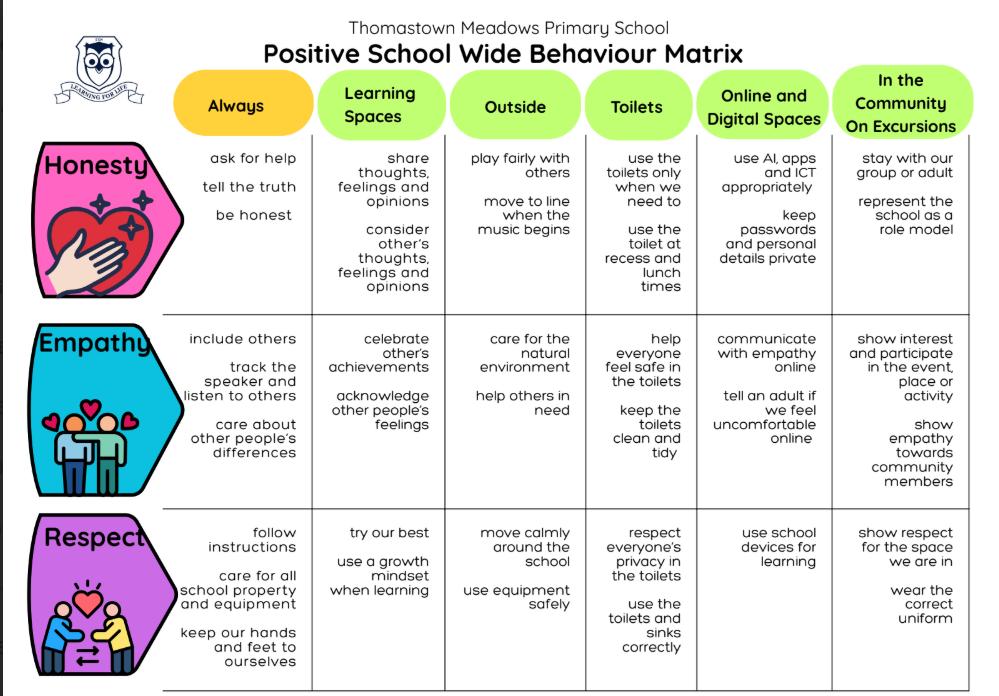
SWPBS is a framework that supports schools to build a positive culture based on shared values and consistent expectations. At Thomastown Meadows Primary School, our Behaviour Expectations Matrix explicitly teaches students what our school values look like across all areas of the school environment.
Throughout the year, staff will continue to explicitly teach, model and reinforce expected behaviours in different settings across the school. By consistently teaching these expectations, we aim to support all students to become successful learners and positive members of the school community. Our focus is on preventing behaviours of concern, teaching appropriate alternatives and recognising positive behaviours.
Our School Values
Our whole-school behaviour matrix outlines what our values look like in different settings including learning spaces, outside areas, toilets, digital spaces and within the wider community. This shared language helps students understand how they can demonstrate honesty, empathy and respect in everyday situations.
At TMPS, we aim to develop happy, active and independent learners who contribute positively to society. By working together as a school community, we create a positive, inclusive and supportive environment where every student is encouraged to thrive.
Our Philosophy
At Thomastown Meadows Primary School, staff and students use a common language to discuss behaviour and expectations. There is a strong emphasis on promoting, teaching and acknowledging positive behaviour. Just like academic learning, expected behaviours need to be explicitly taught and reinforced.
Purpose
The purpose of implementing School Wide Positive Behaviour Support (SWPBS) at Thomastown Meadows Primary School is to:
-
embed a common language and consistent behavioural expectations across the whole school community
-
provide a safe, supportive and orderly environment that enhances learning
-
use evidence-based decision making informed by SWPBS data
-
provide a consistent teaching framework through a behavioural expectations matrix
-
strengthen a culture of positive behaviour through explicit teaching and reinforcement
What is School Wide Positive Behaviour Support?
School Wide Positive Behaviour Support (SWPBS) is a whole-school framework designed to explicitly teach and reinforce positive behaviours. SWPBS includes a range of school-wide and individualised strategies that support positive social, emotional and learning outcomes while preventing behaviours of concern.
SWPBS practices are informed by research and evidence-based approaches shown to be effective in schools. Introducing, modelling and reinforcing positive social behaviours is an important part of every student’s educational experience. Teaching behavioural expectations and recognising students when they demonstrate these behaviours creates a more positive and proactive approach than responding only after inappropriate behaviour occurs.
When SWPBS is implemented effectively, teachers and students have more time to focus on learning, wellbeing and positive relationships.
Benefits of SWPBS
Students and staff benefit from:
-
increased respectful and positive behaviour
-
increased time focused on teaching and learning
-
improved social and emotional wellbeing
-
stronger positive relationships between students and staff
-
consistent evidence-based teaching practices
-
a predictable and supportive learning environment
-
improved perceptions of safety and student engagement
Why Focus on Teaching Positive Behaviours?
Historically, school discipline often focused on reacting to inappropriate behaviour through punishment-based approaches such as reprimands, loss of privileges, suspensions or exclusions.
Research shows that punishment alone, particularly when applied inconsistently and without positive reinforcement strategies, is often ineffective in creating long-term behavioural change.
SWPBS focuses on proactively teaching and reinforcing positive behaviours so students understand what is expected and are supported to make positive choices.
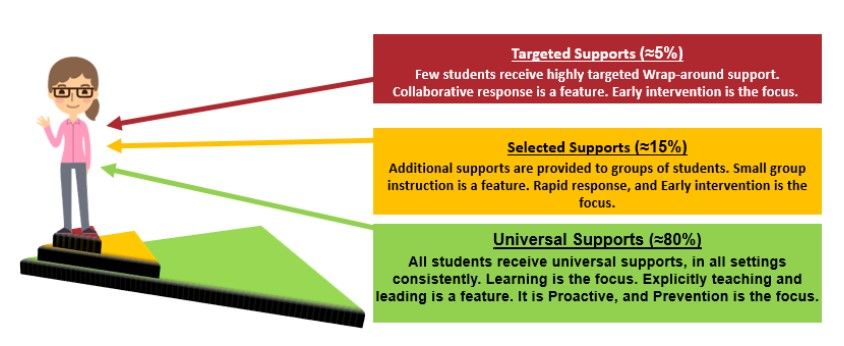
SWPBS Support Tiers
-
Tier 1: Whole-school supports and expectations for all students, based on our values of honesty, empathy and respect.
-
Tier 2: Targeted supports for students requiring additional assistance with emotional regulation, friendships or behaviour skills.
- Tier 3: Individualised supports designed to help students successfully engage in learning and school life.
Hoot Rewards
As part of our Tier 1 SWPBS practices, Thomastown Meadows Primary School has implemented a whole-school positive acknowledgement system called Hoot Rewards.
Aim of the Hoot Rewards System
The Hoot Rewards system has been developed to recognise and reinforce positive behaviours aligned with our school values and expectations.
Students are acknowledged by staff when they demonstrate positive behaviours across the school environment. The reward system is designed to motivate and encourage students through positive reinforcement and shared celebration of success.
Class reward options and experiences are developed in response to student interests and classroom goals, helping to build student engagement and ownership.
The Hoot Rewards System
At Thomastown Meadows Primary School, students can earn Hoot Rewards when they demonstrate expected behaviours and uphold our school values.
Hoot Rewards are used to acknowledge positive choices at both an individual and whole-school level, helping to strengthen a positive and inclusive school culture.
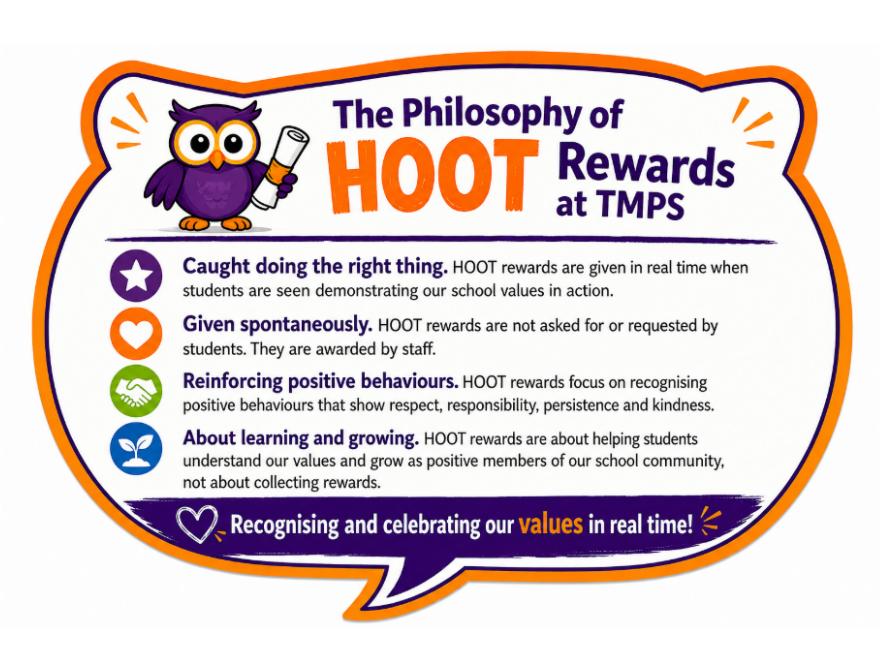
Individual Hoot Rewards
All students have the opportunity to earn Hoot Rewards throughout the school day when positive behaviours are observed.
These rewards are recorded and accumulated over time. Students can work towards classroom-based rewards and experiences linked to their class reward menu.

Whole School Hoot Rewards
Students also contribute towards whole-school rewards and celebrations through the Hoot Rewards system.
As students collectively work towards agreed milestones, the school community may celebrate with whole-school reward events such as:
-
free dress days
-
themed activity days
-
sports activities
-
lunchtime celebrations
-
other student-selected experiences
Whole-school rewards help build a strong sense of community, teamwork and shared success across Thomastown Meadows Primary School.
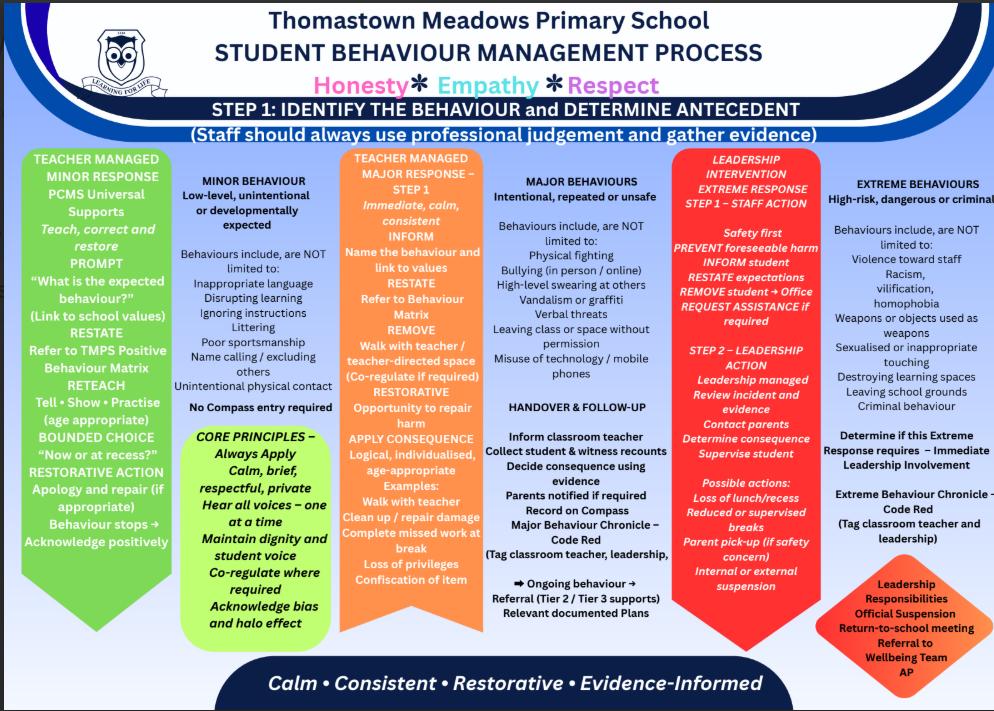
Student Behaviour Management Process
At Thomastown Meadows Primary School, we believe that positive behaviour is best supported through clear expectations, consistent responses and strong relationships.
Our Student Behaviour Management Process provides staff with a consistent, school-wide approach to responding to student behaviour. Grounded in our core values of honesty, empathy and respect, the process ensures that behaviours are managed in a calm, restorative and evidence-informed manner.
Using professional judgement, staff work collaboratively with students to:
-
identify behaviours and possible triggers
-
explicitly reteach expected behaviours
-
support students to repair relationships and restore learning
-
maintain student dignity and wellbeing
-
ensure all students feel safe, supported and included
Our approach prioritises prevention, regulation, restorative practices and positive behaviour support wherever possible. Responses are tailored to the individual needs of students and focus on helping students learn from their experiences while remaining connected to the school community.
The behaviour management process also outlines how the school responds to more serious behaviours, ensuring consistency, safety and appropriate support for all students.